
Zhangjiajie West Railway Station: High-Speed Trains, Tickets, and Transfers
Last updated: Jul 26, 2026
Zhangjiajie West Railway Station (张家界西站) is where almost every high-speed train to Zhangjiajie arrives and departs — if you're coming from Changsha, Chongqing, Chengdu, Guangzhou, or Shanghai by bullet train, this is your station. It sits about 6–8 km northwest of downtown in Yongding District, opened in December 2019, and handles the C, G, and D-series trains that most visitors use. Your foreign passport is your ticket: no paper printout needed, but you will show it at every checkpoint.
Where the Station Is and Key Distances
The station is in the Shadi area of Yongding District, on Wulingshan Avenue (武陵山大道). It is closer to the scenic areas than the older downtown station. Approximate distances and travel times:
| Destination | Distance | By car/taxi | By public transit |
|---|---|---|---|
| Downtown (Dayong Ancient City area) | ~6 km | 12–15 min | ~25 min (Bus 6 / 17) |
| Tianmen Mountain Cable Car Station | ~8 km | 15–20 min | ~30 min (Bus 6 / 17) |
| Zhangjiajie Hehua Airport (DYG) | ~10 km | 18–22 min | 35–40 min (Bus 17) |
| Wulingyuan Scenic Area (East Gate) | ~28 km | 35–40 min | ~50 min (direct tourist bus) |
| Grand Canyon & Glass Bridge | ~42 km | 55–60 min | ~80 min (coach) |
High-Speed Routes from Zhangjiajie West
The station sits on two lines: the Qianjiang–Zhangjiajie–Changde railway and the Zhangjiajie–Jishou–Huaihua high-speed railway. The main routes for tourists (fastest train, second class):
| Route | Fastest travel time | Approx. 2nd class fare |
|---|---|---|
| Changsha South | ~2 hours (20+ trains daily) | ~¥160 |
| Fenghuang Gucheng (Fenghuang Ancient Town) | ~1 hour | ~¥55 |
| Chongqing West | ~2.5 hours | ~¥210 |
| Chengdu East | ~5 hours | ~¥410 |
| Guangzhou South | ~5.5–6 hours | ~¥570 |
| Shanghai Hongqiao | ~9.5–10 hours | ~¥775 |
Slower trains on the same routes can take significantly longer (Changsha services range from under 2 hours to 3.5 hours), so check the duration, not just the price, when booking.
Timetables and fares change with seasonal schedule adjustments. Confirm times and prices on China Railway 12306 or Trip.com before you book — treat the numbers above as planning estimates.

How to Buy Tickets with a Foreign Passport
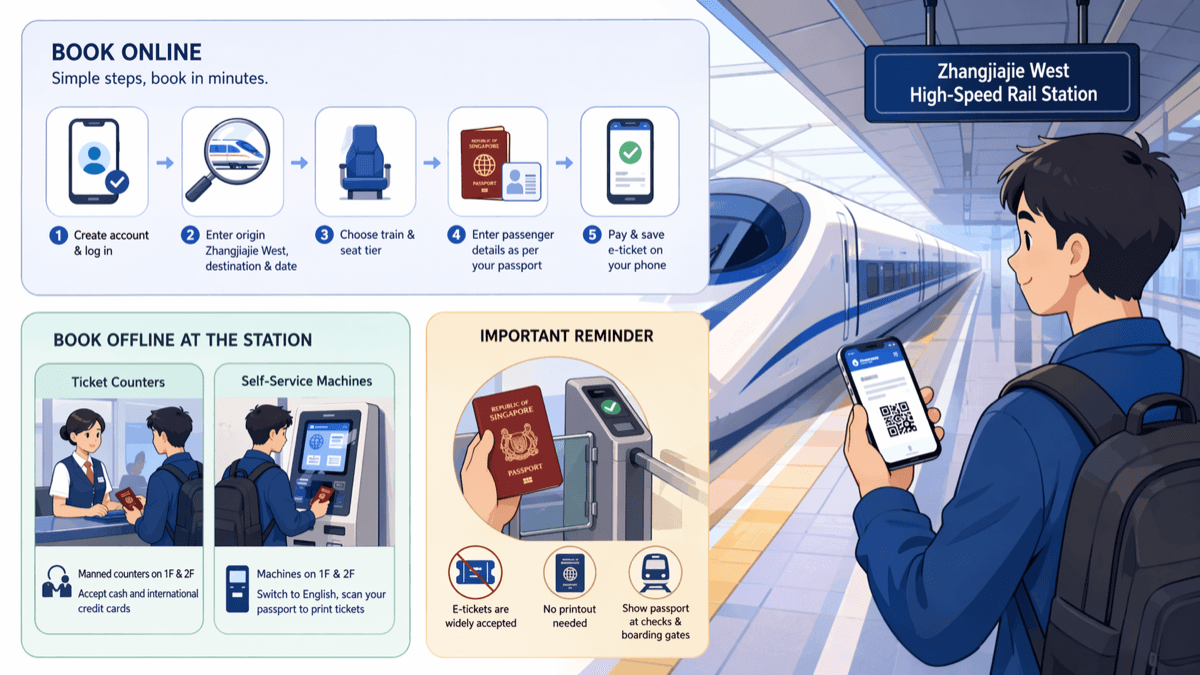
China's rail system is fully e-ticketed: your passport is your ticket, and no printout is required. Tickets go on sale 15 days before departure.
- 12306 (official, face value): China Railway 12306 has an English interface and accepts foreign passports. Register your account and submit your passport for verification a few days before booking — manual approval can take from a few hours up to 1–2 working days. Enter your name exactly as it appears in your passport's machine-readable zone, including middle names.
- Trip.com (easiest fallback): Ctrip / Trip.com accepts foreign phone numbers and international cards, with a full English booking flow and English customer support, for a small service fee.
- At the station: the staffed ticket windows (售票处) can sell tickets and handle changes or refunds for passport holders. At least one window typically handles manual passport checks — don't rely on the self-service machines, which generally require a Chinese ID card.

Departing from Zhangjiajie West: Step by Step
1. Arrive 45–60 minutes early
Allow 75 minutes in peak season (July–August, Golden Week in early October). The station is modern but passport checks take longer than ID-card gates.
2. Enter through the manual lane
At the entrance, show your passport at the staffed manual verification lane — the automatic gates read Chinese ID cards only. All bags go through the X-ray scanner.
3. Find your gate in the 2F waiting hall
Check the departure boards for your train number and gate (e.g., Gate 3A or 3B). Ticket offices, food shops, restrooms, and drinking water stations are all on this level.
4. Board via the manual lane
Boarding opens about 15–20 minutes before departure and closes 5 minutes before. Show your passport to staff at the manual lane beside the turnstiles, then take the escalator down to the platform (1F).
5. Find your car and seat
Car numbers are marked on the platform floor and overhead displays. Your seat assignment (e.g., Car 04, Seat 08C) is in your booking confirmation.
Arriving and Getting Onward Transport
After getting off the train, follow the green "Exit" (出口) signs down to the B1 arrival level, show your passport at the manual exit lane, and choose your onward transport.
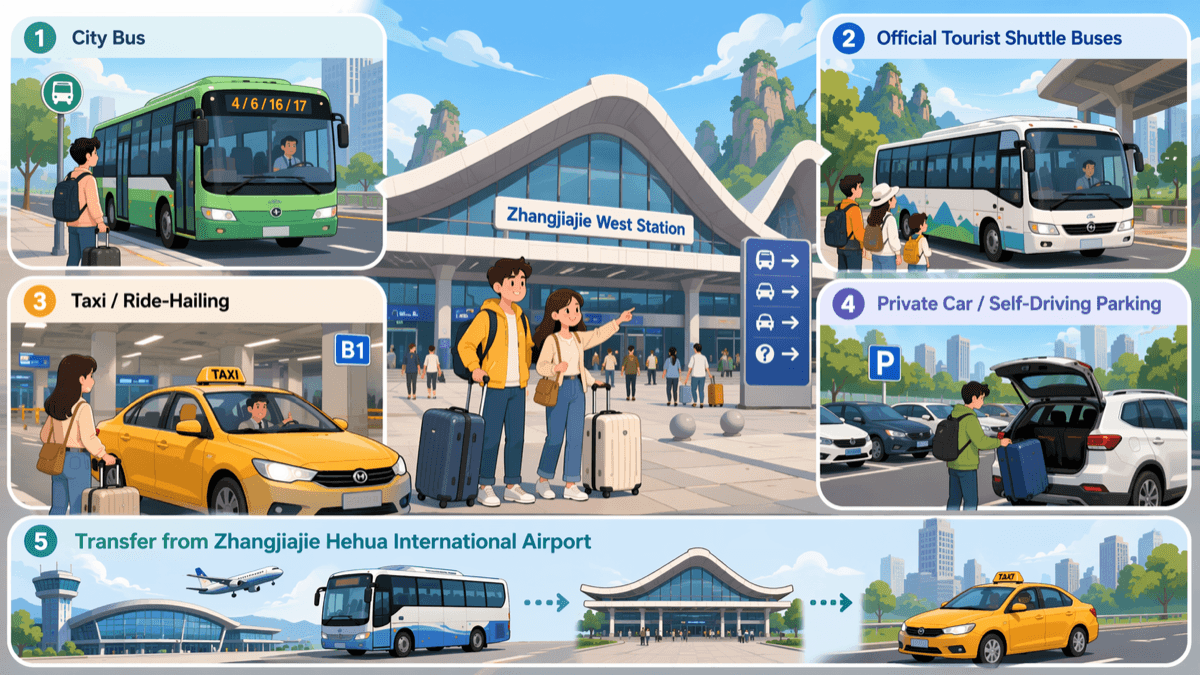
- City buses: Bus 6 runs to downtown and the Tianmen Mountain Cable Car lower station; Bus 17 runs between the station and the airport via downtown. Fare is ¥2 per ride — pay with exact cash or a transport QR code in Alipay or WeChat.
- Taxi: follow the bilingual signs to the official taxi queue on B1. Drivers use the meter; downtown costs roughly ¥20–30 and the Tianmen cable car station about ¥25–45.
- Ride-hailing: Didi pickups use the designated pick-up lanes — set your pickup point in the app and follow the in-app walking directions.


To Wulingyuan Scenic Area (Zhangjiajie National Forest Park)
- Direct tourist bus: coaches run from the station's adjacent long-distance bus terminal (客运站) to Wulingyuan Bus Station, roughly every 15–30 minutes through the daytime (about 08:30–17:00), leaving when full. The ride takes 40–50 minutes and costs about ¥13–15.
- Taxi/Didi: 35–40 minutes to the Wulingyuan East Gate (Signpost Gate), roughly ¥80–110.
To Tianmen Mountain
Take Bus 6 or 17 to the Tianmen Mountain Cable Car Station stop (~30 minutes), or a taxi (~15–20 minutes, about ¥25–45). The cable car base station is in the city center, not at the mountain itself.
To Zhangjiajie Grand Canyon & Glass Bridge
Take a coach from the station terminal bound for the Grand Canyon or Jiangya (about 80 minutes), or go to Wulingyuan first and transfer to a local minibus. A direct taxi takes 55–60 minutes and costs roughly ¥120–150.
Inside the Station: Layout and Facilities
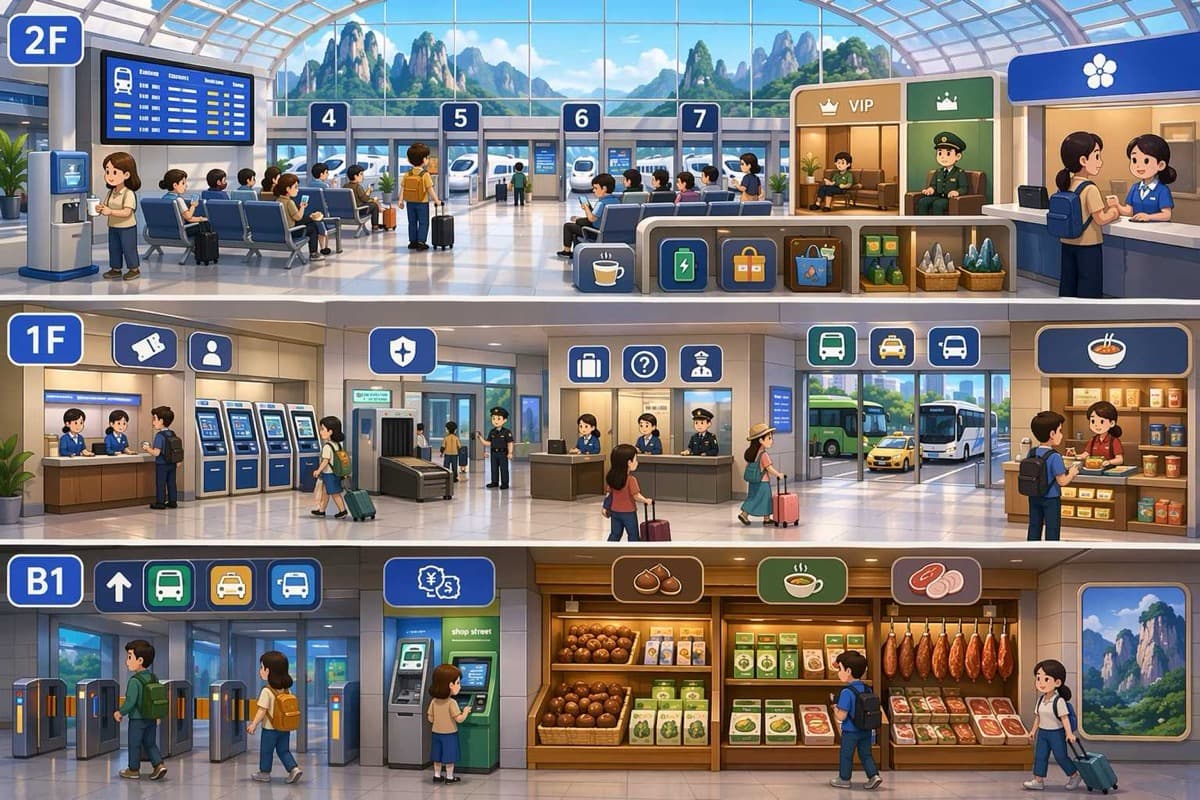
- 2F — departures: security check, waiting hall, boarding gates, ticket windows, food and convenience stores, restrooms, drinking water.
- 1F — platforms: tracks and boarding platforms, reached by escalator or elevator when boarding opens.
- B1 — arrivals: exit gates, taxi queue, city bus bays, and the long-distance coach terminal.
Luggage storage (left-luggage counter and lockers, roughly ¥10–30 per day depending on size) is available near the ticket hall and departure lounge. Charging posts and rentable power banks are scattered through the waiting areas — renting one requires Alipay or WeChat.
Zhangjiajie West vs Zhangjiajie Station: Don't Mix Them Up
The city has two stations, about 10 km apart:
- Zhangjiajie West (张家界西站) — the high-speed hub for G, D, and C trains. Almost all tourists arrive here.
- Zhangjiajie Station (张家界站) — the older downtown station for slow conventional trains (K, T, Z series), near the Tianmen Mountain cable car.
Always check which station is printed on your ticket. If your hotel is downtown and you booked a slow overnight train, you may want the old station — but for everything high-speed, it's Zhangjiajie West.
Practical Tips
- Luggage limits on high-speed trains: 20 kg per adult, with combined length + width + height of 130 cm or less. Aerosol sprays over 120 ml and knives (including Swiss Army knives) are confiscated at security.
- Keep your passport in hand: you'll show it at least three times — entering the station, boarding, and exiting at your destination.
- Save the Chinese address: 张家界西站 (Wulingshan Avenue, Yongding District) on your phone to show taxi drivers.
- Set up mobile payment before you arrive: ticket shops, buses, and taxis overwhelmingly take Alipay or WeChat Pay over cash or foreign cards.
- Everything runs on Beijing time — boarding gates close 5 minutes before departure, and trains do not wait.